Window Replacement in Arizona: What Drives the Cost, How Long It Takes, and What Happens on Installation Day
By the team at VIP Smart Windows, Fountain Hills, Arizona. Last updated September 2026.
Most homeowners start the window replacement conversation with one question: what is this going to cost? It is the right question, and it is also the one nobody can honestly answer from a website. A window project is priced from your openings, not from an average.
Two houses on the same street can have the same square footage and land in very different places because one has eight standard openings and the other has twenty two, including three oversized west facing spans and a patio door.
What we can do is show you exactly what moves the number, what the timeline actually looks like from the first conversation to the final walkthrough, and what happens in your home on installation day.
Why Window Replacement in Arizona Is a Different Job
A window in Phoenix, Scottsdale, or Fountain Hills lives a harder life than a window almost anywhere else in the country. Summer surface temperatures on a west facing frame climb far past ambient air temperature. That heat cycles every single day, expanding the frame in the afternoon and contracting it overnight, and it does that for decades.
Add intense ultraviolet exposure, monsoon driven dust that works into every track and seal, and seasonal wind that pushes that dust hard against the glass line.
The practical result is that Arizona exposes weak construction faster than a mild climate does. Frames that flex, single chamber extrusions, stamped hardware, and marginal seals all survive longer in Oregon than they do here.
This is the whole reason VIP builds on European engineering: multi chamber frames, precision seals, Italian hardware, and multi point locking, manufactured in house in the USA.
It also changes how you should read a low quote. In this climate, the money you save at purchase tends to come back as a service call in year six.
The Two Paths: Full Frame Replacement vs. Insert Replacement
Nearly every residential window project takes one of two forms, and which one your home needs is usually decided by the condition of the existing opening rather than by preference.
Insert or Retrofit Replacement
The old sash and glass come out, the existing frame stays in place, and the new window is set inside it. The exterior stucco and interior trim are largely undisturbed.
It is faster and less invasive, and it is the right call when the existing frame is square, dry, and structurally sound.
Full Frame Replacement
Everything comes out down to the rough opening, including the old frame. The new window is set, flashed, insulated, and sealed against the actual structure, then the exterior and interior finishes are restored.
It takes longer and touches more of the house, and it is the right call when there is water intrusion, frame rot or corrosion, out of square openings, or when you are changing the size or operating style of the window.
| Factor | Insert Replacement | Full Frame Replacement |
|---|---|---|
| Existing frame | Stays in place | Removed completely |
| Glass area | Slightly reduced | Preserved or increased |
| Sealing and flashing | Limited to the existing frame | New flashing to the structure |
| Stucco and trim impact | Minimal | Exterior and interior finish work required |
| Time per opening | Shorter | Longer |
| Best use | Sound, square, dry openings | Damaged openings, size or style changes |
An honest measure appointment tells you which one you need. Be cautious of any company that decides before it looks.
What Actually Drives the Cost of a Window Replacement Project
Here is the full list of variables that move a window quote up or down. No two of these matter equally on every house, but every quote you receive is built from them.
Number of Openings
This is the single biggest lever. Manufacturing, delivery, and installation all scale with count, though the per opening figure usually improves as the project gets larger because mobilization is spread across more work.
Size and Configuration
A large picture window with a fixed center and two operating flankers is a different product than a standard bedroom window. Oversized glass is heavier, needs more structural support, and often needs more installers on site to set safely.
Style and Operation
Fixed glass is the simplest. Sliding and double hung windows add moving parts. Casement adds a hinge and crank system. Tilt and turn adds a dual function mechanism with the hardware complexity that comes with it.
Glass Package
Low emissivity coatings, the number of glass layers, the gas fill, and the acoustic interlayer all affect performance and price. In Arizona the coating and layering are not a luxury upgrade.
Frame Construction
Multi chamber frames insulate better and stay dimensionally stable through heat cycling than single chamber extrusions. Chamber count, reinforcement, and seal precision are where much of the quality difference lives.
Full Frame vs. Insert
Full frame replacement adds removal labor, flashing, insulation, and finish restoration on both sides of the wall. On a compromised opening it is the only correct answer.
Stucco, Framing, or Water Damage
If the opening has taken on water, the repair happens before the window goes in. This is one of the reasons the measure appointment matters.
Access and Story Height
Second story openings, windows over a roofline, windows above a pool, and openings reachable only through a narrow side yard all add time, equipment, and crew.
Finish and Hardware Selections
Frame color inside and out, hardware finish, grid patterns, and screen type are usually modest individually and add up across a whole house.
Doors in the Same Project
Sliding, French, entry, and bi fold doors have their own cost drivers, and adding one to a window project changes the total.
Notice what is not on this list: a per window sticker price. Anyone who quotes you a firm number before measuring your openings is quoting a guess, and the guess gets corrected later.
Where Cheap Windows Get Expensive Later
The cost conversation is incomplete if it stops at the invoice. A few failure patterns show up again and again on Arizona homes, usually six to ten years after a budget replacement.
The insulated glass unit loses its seal, moisture gets between the layers, and you get permanent fogging. The glass has to be replaced. The frame is still in the wall.
Stamped or lightweight hardware in a heat cycled frame develops play. Locks stop engaging cleanly, sashes stop sitting flush, and air and dust start coming through.
A frame that expands and contracts more than the sealant can accommodate opens a gap at the perimeter. That gap is where dust and monsoon water enter.
Read what the warranty actually covers, for how long, whether labor is included, and whether it transfers. A short glass only warranty and a lifetime limited warranty are very different promises.
VIP builds against these specific failure modes: multi chamber frames for dimensional stability, Italian hardware, multi point locking that pulls the sash evenly into the seal, and a lifetime limited warranty behind the product.
Step One: The Free Design Consultation and On Site Measurement
Every VIP project starts with a free design consultation. It is not a sales presentation with a folder of brochures. It is the appointment where the project is actually defined.
This appointment is what converts a rough idea into a specification and a firm number. Because VIP manufactures in house, the measurements taken here go straight into production rather than through a distributor.
You can review VIP's consultation, manufacturing, and installation process before your appointment.
Step Two: Custom Manufacturing, Four to Eight Weeks
Built to Your Openings
VIP windows and doors are built to the openings in your home, not pulled from a shelf of standard sizes. The in house manufacturing window is four to eight weeks depending on the size of the project and the specifications selected.
Fabrication and Assembly
Frames are cut and welded to your dimensions, chambers reinforced, glass units built with the specified coatings and layering, Italian hardware fitted, multi point locking installed and adjusted, and finishes applied. Each unit is checked before it ships.
Control When the Clock Starts
A custom product built to your openings takes the time it takes. What you can control is when the clock starts. If you want new windows in before summer, the consultation belongs in late winter, not in May.
This is also the stage where a stock window and a custom window separate. A stock unit is available immediately because it was built to a standard size, which means it gets shimmed and sealed into an opening it does not exactly fit.
Step Three: Installation Day, Start to Finish
VIP installs with its own in house team, not a subcontracted crew, which matters because the people setting the window answer to the people who built it.
The crew confirms the plan, covers floors, and moves or protects furniture near each opening. Interior work areas get contained.
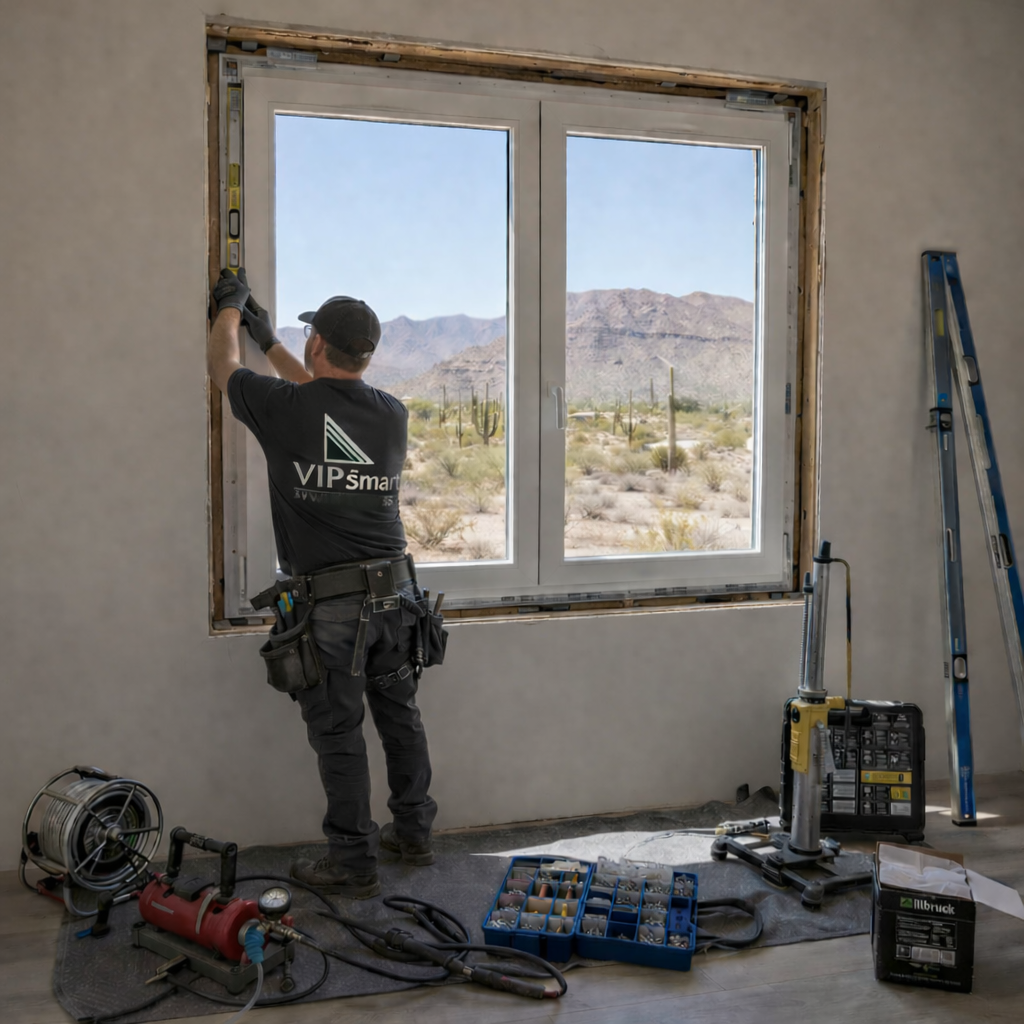
The old window comes out. On an insert replacement that means the sash and glass. On a full frame replacement the frame comes out too, exposing the rough opening.
With the old unit out, the crew can see the actual condition of the framing and sill. If there is hidden damage, this is when it surfaces and gets addressed.
The new window is set into the opening, shimmed, checked for level, plumb, and square, and fastened. Square decides whether the sash seals evenly for the next thirty years.
The perimeter is insulated and sealed, and on a full frame replacement the flashing is integrated with the wall so water is directed out rather than in.
Exterior stucco or trim and interior casing are restored. Hardware is installed and adjusted, and the locking points are set.
Every sash is opened, closed, locked, and unlocked. Tilt and turn units are checked in both positions.
Old units and packaging are removed, glass is cleaned, and work areas are returned to condition.
The crew walks the job with you, demonstrates operation and cleaning on each style, and explains the warranty coverage.
Most homes are a one day or two day install. A large whole home project with full frame replacement and stucco restoration runs longer, and your consultation should give you a specific expectation rather than a general one.
The Full Timeline at a Glance
| Stage | What Happens | Typical Duration |
|---|---|---|
| Free design consultation | Needs, styles, glass package, budget drivers discussed | One appointment |
| On site measurement | Every opening measured and assessed | Same visit or a scheduled follow up |
| Proposal and selections | Firm specification, colors, hardware, glass confirmed | Depends on your decisions |
| Order release | Specifications move into production | Immediately on approval |
| In house manufacturing | Frames, glass units, hardware built to your openings | Four to eight weeks |
| Installation scheduling | Install date confirmed as production completes | Coordinated in advance |
| Installation | Removal, setting, sealing, finish, operation check | One day for most homes, longer for large or full frame projects |
| Final walkthrough | Operation demonstrated, warranty explained | Same day as install |
When Replacement Is Not the Right Call Yet
Not every window problem is a replacement problem, and it does not serve anyone to pretend otherwise.
If you are seeing failure across most of the openings in the house, fogging in multiple units, rooms that never hold temperature, dust accumulating on interior sills, and locks that no longer seat, that pattern points to replacement rather than repair.
Doing Windows and Patio Doors in the Same Project
Patio doors are the largest glass openings in most Arizona homes and often the worst performing. If your sliding door is original to the house and your windows are being replaced, doing both together is usually the better sequence.
VIP builds sliding, French, entry, and bi fold doors in the same in house operation as the windows. You can explore VIP's window and door services to review the broader product range.
Questions to Ask Any Window Company Before You Sign
You can check performance numbers independently. The NFRC label on a window reports U factor, solar heat gain coefficient, and visible transmittance using a standardized method, and ENERGY STAR publishes the criteria for the southern climate zone that Arizona falls into. Any reputable company will hand you those numbers without hesitation.
Frequently Asked Questions
How much does window replacement cost in Arizona?
It is priced from your openings rather than from an average, because the count, size, style, glass package, frame construction, and whether the job is insert or full frame replacement all move the number substantially. The only accurate figure comes from an on site measurement. VIP provides that consultation free, and because the windows are manufactured in house there is no distributor margin between you and the product.
How long does window installation take?
The installation itself is typically one day for most homes and two days for larger projects. Whole home full frame replacement with stucco restoration takes longer. The longer part of the schedule is the four to eight week custom manufacturing window before installation day.
Do I need to be home during the installation?
Someone should be home at the start so the crew can confirm the plan and access, and at the end for the final walkthrough and operation demonstration. You do not need to stand over the work in between.
How much mess does window replacement make?
There is dust, particularly on full frame replacement where stucco and trim are cut. A professional crew contains the work area, protects floors and furniture, and cleans up at the end of each day. Ask specifically how the crew handles containment before you book.
What happens if a measurement is off?
This is precisely why the measurement is done by the people responsible for the outcome rather than handed off. With in house manufacturing and in house installation, a discrepancy is corrected within one organization instead of becoming a dispute between a supplier and an installer.
Can windows be replaced during an Arizona summer?
Yes. The work is done opening by opening, so the house is never wide open, and crews start early to work around afternoon heat. Many homeowners plan the consultation in winter or spring specifically so installation lands before peak summer, but summer installation is routine.
Should I replace all my windows at once or a few at a time?
Doing the whole house at once is generally more efficient because mobilization, manufacturing, and installation are consolidated. Phasing is workable when you prioritize the worst performers first, which in Arizona usually means the west and south facing openings.
Is full frame replacement always better than an insert?
No. If the existing frame is square, dry, and sound, an insert replacement is less invasive and performs well. Full frame becomes the right answer when there is water damage, an out of square opening, or when the size or operating style is changing.
Do new windows really reduce cooling costs in Phoenix?
Glass is where a large share of heat enters an Arizona home, so low emissivity coatings, multi layer insulated glass, and a well sealed multi chamber frame reduce the load your cooling system carries. Actual savings depend on your current windows, your home, and your usage, so treat any company quoting you a guaranteed percentage with skepticism.
Do window replacements require a permit in Arizona?
It depends on your municipality and on the scope. Like for like insert replacement is often treated differently than altering the size of a structural opening. Cities across the Phoenix metro publish their own requirements, and your installer should tell you which category your project falls into before work starts.
Talk to VIP Smart Windows
VIP Smart Windows designs, manufactures, and installs European engineered windows and doors from Fountain Hills, Arizona, serving Fountain Hills, Phoenix, Scottsdale, Mesa, Tempe, Chandler, and Gilbert.
Every product is built in house to your openings with multi chamber frames, Italian hardware, multi point locking, Low E glass, and multi layer insulated glass with acoustic seals, backed by a lifetime limited warranty.
Because VIP manufactures and installs with its own team, there is no middleman between the measurement and the finished installation, and no distributor markup between the factory and your home.
VIP Smart Windows
16939 E. Colony Drive, Fountain Hills, AZ 85268
(480) 842-9225
Get a Firm Number Built From Your Actual Openings
Schedule your free design consultation and let the VIP Smart Windows team measure the openings, assess the existing frames, review glass and hardware options, and define the installation scope before the project goes into production.
Written by the VIP Smart Windows team. Serving Fountain Hills, Phoenix, Scottsdale, Mesa, Tempe, Chandler, and Gilbert with custom European engineered windows and doors, manufactured and installed in house.