How Soundproof Windows Stop Street Noise in Arizona
By VIP Smart Windows — Fountain Hills, AZ | Serving Phoenix, Scottsdale, Mesa, Tempe, Chandler & Gilbert
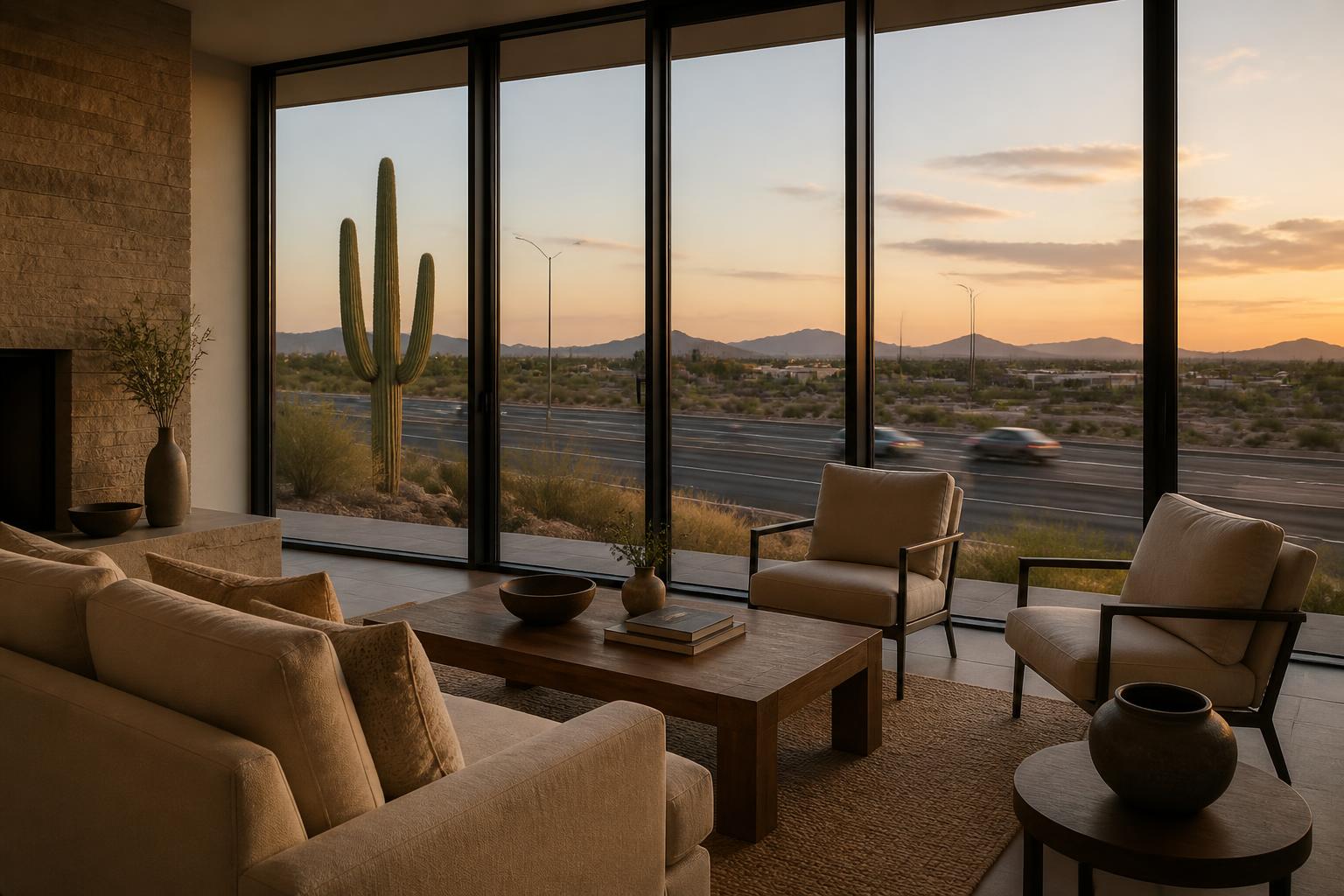
You bought the house for the mountain views, the pool, and the desert quiet. Then the Loop 101 got busier, the arterial three blocks over widened, and a new distribution center pushed truck traffic onto your street. Now the low rumble starts at 5 a.m. and does not really let up until after 10 p.m.
It is one of the most common quality-of-life complaints we hear from homeowners across Scottsdale, Chandler, Gilbert, Mesa, and Tempe — and it is almost always solvable. The right windows can turn a house that feels like it sits on a freeway into one that feels like it sits in the desert again.
This guide explains how soundproof — technically, sound-reducing — windows work, what homeowners should look for, and what makes a real acoustic package different from a builder-grade dual-pane window.
Why Standard Arizona Windows Let So Much Noise In
Most tract homes across the Valley were built with the cheapest window package the builder could specify: single-chamber vinyl frames, thin dual-pane glass with equal-thickness lites, and basic weatherstripping. That package was optimized for one thing — meeting minimum energy code at the lowest possible cost — not for keeping sound outside.
Three weak points do most of the damage:
Thin, Equal-Thickness Glass
Two panes of the same thickness resonate at the same frequency, so sound waves pass through the assembly instead of being disrupted or absorbed.
Single-Chamber Frames
A hollow vinyl frame with no internal chambers can behave like a drum, transmitting vibration from the exterior directly into the surrounding wall.
Worn Compression Seals
After years of 115°F afternoons, builder-grade weatherstripping can flatten and shrink. Air gaps quickly become direct pathways for traffic and neighborhood noise.
A window does not need a large visible gap to leak noise. Even tiny breaks in the perimeter seal can undermine the performance of the entire glass package.
STC Ratings in Plain English
STC, or Sound Transmission Class, is an industry rating used to describe how much sound an assembly blocks. Higher numbers indicate greater sound reduction. The scale is not linear, so a seemingly modest increase in rating can create a noticeable improvement inside the home.
| STC Rating | What You Actually Hear | Typical Window |
|---|---|---|
| 25 | Normal speech can be clearly understood through the window. | Standard single-pane window |
| 28 | Loud speech is understandable and nearby television audio may remain audible. | Basic builder-grade dual-pane window |
| 32 | Loud speech becomes faint, but traffic remains noticeable. | Better dual-pane vinyl window |
| 35 | Loud speech is reduced to a murmur and traffic noise is softened. | Quality dual-pane window with effective seals |
| 38–42 | Most freeway and street noise fades into the background. | Multi-chamber European dual-pane system with acoustic seals |
| 45+ | Freeway noise becomes a distant hush and conversation privacy is substantially restored. | Laminated or asymmetric triple-pane acoustic package |
For many Phoenix-metro homes with moderate traffic exposure, an STC 35–38 package offers an effective balance of sound reduction, thermal performance, and project cost.
Homes directly on a major arterial or within roughly a mile of Loop 101, US-60, or I-10 may benefit from an STC 40+ package.
How Sound Actually Gets Through a Window
Four physical principles determine which sounds a window blocks and which sounds pass through the assembly.
M Mass
Heavier glass blocks more low-frequency sound, including truck engines, bass, and freeway rumble. This is why laminated and triple-pane packages are often considered for freeway-adjacent homes.
A Air Gap
The space between panes helps decouple the glass. Wider gaps and panes with dissimilar thicknesses disrupt resonance more effectively than matching panes placed close together.
D Damping
A laminated PVB interlayer converts a portion of sound energy into tiny amounts of heat within the glass sandwich, helping reduce speech, sirens, dogs, and other mid-frequency noise.
S Sealing
Even advanced glass will underperform if the sash does not compress evenly against the frame. Small air gaps around the perimeter can become major sound leaks.
What Makes a Window Truly Acoustic: The VIP Approach
VIP Smart Windows uses European-engineered window and door systems manufactured in the United States for demanding climates. The same features that help these systems perform in Arizona heat also make them effective sound barriers.
Multi-Chamber uPVC Frames
Internal air chambers interrupt vibration paths between the exterior and interior, allowing the frame to function as part of the acoustic barrier instead of acting like a hollow drum.
Multi-Layer Insulated Glass
VIP can specify asymmetric glass lites, wider air spaces, and laminated options tuned to the traffic, aircraft, neighborhood, and HVAC noise affecting the property.
Precision Acoustic Seals
Two- and three-point compression gaskets maintain continuous contact around the sash instead of relying on basic glued-on foam weatherstripping.
Italian Multi-Point Locking Hardware
Multiple locking points pull the sash tightly and evenly into the frame, helping close the micro-gaps that frequently leak sound through lower-quality windows.
European Tilt-and-Turn Geometry
When closed, the sash seats firmly into a continuous perimeter seal. This design can provide a tighter acoustic closure than sliding and single-hung systems that require operational clearance.
Explore the full range of VIP Smart Windows services and window systems available for replacement, new construction, and custom Arizona homes.
Double-Pane vs. Triple-Pane vs. Laminated Glass for Sound
Not every home needs triple-pane glass. The right package depends on the frequency and intensity of the noise affecting the property.
| Glass Package | Sound Reduction | Best For |
|---|---|---|
|
Standard dual-pane 3 mm / 3 mm |
Baseline performance with limited improvement against mid-frequency noise. | Homes without significant noise exposure |
|
Asymmetric dual-pane 3 mm / 6 mm |
A meaningful reduction in traffic-band noise and better performance than equal-thickness glass. | Moderate street noise and arterial-road exposure |
|
Laminated dual-pane With PVB interlayer |
Strong performance across speech and traffic frequencies, with additional UV and security benefits. | Homes near freeways, flight paths, barking dogs, or busy neighbors |
|
Triple-pane With acoustic seals |
Excellent low-frequency reduction with the strongest overall thermal performance. | Homes directly on Loop 101, US-60, I-10, or beneath aircraft approach paths |
Triple-pane is not automatically the best solution for every sound. Laminated dual-pane glass can outperform a basic triple-pane package against voices, dogs, sirens, and other mid-frequency noise.
Triple-pane glass generally performs well against low-frequency truck rumble and freeway bass while also improving thermal performance during Arizona summers. When a home has both severe low-frequency and mid-frequency exposure, a laminated triple-pane package may provide the most comprehensive result.
Neighborhood-Specific Guidance Across the Valley
Scottsdale
Homes near the Loop 101 corridor, Scottsdale Airport approach paths, and Old Town nightlife zones often benefit from laminated glass because it addresses a mixture of freeway, aircraft, and voice-frequency noise.
Chandler & Gilbert
Continued growth has placed more homes near Chandler Boulevard, Warner Road, Ray Road, Val Vista Drive, and other major arterials. An STC 35–38 dual-pane package with strong seals is often an effective starting point.
Mesa & Tempe
US-60 and Loop 202 traffic are common concerns. Homes near these corridors may benefit from asymmetric or laminated glass because low-frequency truck noise can penetrate basic dual-pane windows.
Phoenix & Fountain Hills
Homes near Camelback, Bell, Cactus, Sky Harbor approach routes, Shea Boulevard, or the Beeline may need a package tailored to traffic and aircraft frequencies rather than a generic replacement window.
Bonus Benefits You Get With an Acoustic Window Package
A well-designed acoustic window package does more than quiet the home. The same design features can improve several other aspects of indoor comfort.
Improved thermal performance: Greater glass mass, insulated cavities, and stronger seals also help reduce heat transfer into the home.
Dust and pollen control: Continuous gaskets and multi-point locking systems help keep monsoon dust and outdoor allergens outside.
UV protection: Low-E coatings and laminated interlayers can help protect flooring, artwork, furniture, and interior finishes from fading.
Greater security: Laminated glass is more difficult to penetrate, while multi-point locks provide a stronger mechanical barrier.
Signs Your Current Windows Are the Weak Link
Before investing in wall insulation or interior acoustic treatments, test the windows. In many Valley homes, the glass, frame, or perimeter seal is the primary path carrying outdoor noise inside.
The Drive-By Test
Stand next to a closed window when a truck passes. If you can clearly identify the vehicle type by sound, the existing window is providing limited acoustic separation.
The Feel Test
Run your hand around the perimeter of the closed sash on a windy day. Airflow that can be felt around the window represents a direct path for outdoor sound.
The Sunset Temperature Test
Touch the glass around 5 p.m. on a hot summer day. Glass that feels unusually hot may also be part of an underperforming window assembly with limited thermal and acoustic resistance.
What to Expect From a VIP Acoustic Consultation
Every property has a different combination of road orientation, room layout, glass area, wall construction, and noise frequency. VIP does not approach acoustic projects with a single off-the-shelf package.
Free on-site consultation and identification of the primary noise sources
Professional measurement of each opening to eliminate ordering guesswork
Custom glass, frame, and seal recommendations based on the home's noise profile
In-house manufacturing completed for the home's exact openings
Professional installation and lifetime limited warranty support
Learn more about the VIP consultation, manufacturing, and installation process .
Find the Right Acoustic Package for Your Home
VIP Smart Windows can evaluate the traffic, aircraft, neighborhood, or mechanical noise affecting your home and recommend a package based on the actual problem — not simply the most expensive glass option.
Frequently Asked Questions
What is the difference between STC and OITC ratings?
STC, or Sound Transmission Class, evaluates performance across a broad frequency range weighted toward speech. OITC, or Outdoor–Indoor Transmission Class, gives greater weight to low-frequency outdoor noise such as traffic and aircraft. For an Arizona home near a freeway or flight path, it is helpful to compare both ratings.
Can I add soundproofing to my existing windows, or do I need replacements?
Interior storm windows and acoustic inserts may provide a modest improvement, but they do not necessarily correct frame vibration, worn seals, or the resonance of thin, equal-thickness glass. Replacement windows generally provide a more complete solution while also improving thermal performance, security, and dust sealing.
Will my HOA approve replacement windows?
Many Valley HOAs approve replacement windows when the exterior appearance, frame color, grid pattern, and sightlines remain consistent with community requirements. VIP can help provide the product and project documentation needed for an architectural submittal.
How much do sound-reducing windows cost?
Pricing depends on the number and size of openings, frame configuration, operating style, and glass package. Because VIP manufactures in-house and sells directly, homeowners avoid an additional distributor layer. A free on-site consultation provides project-specific measurements and pricing.
Do storm windows or window films actually work?
Window films provide little meaningful sound reduction because they add very little mass or separation. Storm windows can provide some improvement, but they may introduce maintenance and cleaning concerns in dusty, monsoon-prone conditions. Neither option fully replaces a tightly sealed, acoustically tuned window assembly.
Will new windows help with barking dogs and neighbor noise?
Yes. Voices, barking dogs, and many neighborhood sounds fall into the mid-frequency range where laminated glass performs well. A properly designed laminated dual-pane package may outperform a basic triple-pane window against these specific sounds.
Does triple-pane glass really matter in Arizona?
Triple-pane glass can be worthwhile for homes facing major freeway corridors, heavy truck traffic, severe west-facing heat exposure, or aircraft noise. For many other Valley homes, a carefully designed laminated dual-pane package provides an effective balance of price, sound reduction, and energy performance.
Ready to Get Your Quiet Back?
If freeway noise, arterial traffic, aircraft, or a busy neighborhood is taking away the comfort of your home, the right window package can make a significant difference.
VIP Smart Windows offers free design consultations across Phoenix, Scottsdale, Mesa, Tempe, Chandler, Gilbert, and Fountain Hills. The VIP team will evaluate your specific noise problem, measure your openings, and recommend an acoustic package suited to your home.